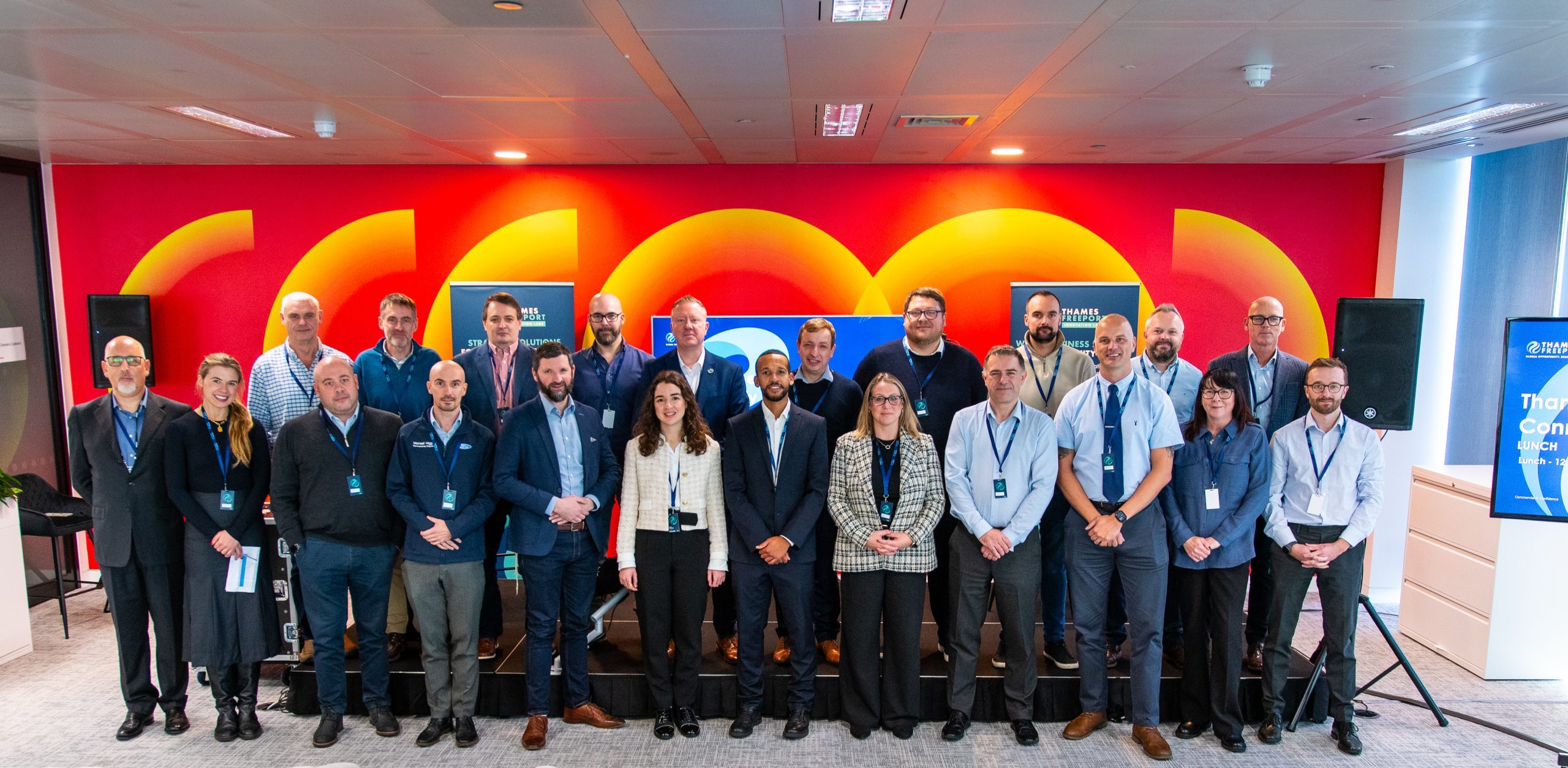
Following the announcement of the eight companies selected to take part, Thames Freeport’s Connectivity Lab is now moving into live trials across sites along the Thames Estuary.
The Lab is designed to test technologies that are already in use elsewhere and prove whether they deliver value in real operational conditions. Rather than running isolated pilots, participating companies are embedded directly into day to day environments where safety, scale and reliability matter.
The programme operates across three nationally significant sites: DP World London Gateway, Port of Tilbury and Ford Dagenham. Together, they represent one of the UK’s most important logistics and manufacturing corridors.
Why this approach matters
Ports and industrial sites are complex places to operate. Technologies that work in controlled environments often struggle when exposed to live operations and safety critical processes.
The Connectivity Lab focuses on solving that problem. It gives companies the chance to work alongside operators and test their solutions under real conditions, helping determine what is ready to scale and what still needs work.
This approach reflects Thames Freeport’s wider focus on delivery rather than demonstration, ensuring innovation activity is grounded in operational reality.
From announcement to live trials
In November companies who applied took part in a pitch day. Watch this video with the highlights of that day. The eight participating companies were selected from a strong field of applicants from the UK and overseas. Each has entered a ten week programme delivered with L Marks and Cambridge Management Consulting, working closely with site partners to validate specific use cases.
The trials build on the Freeport’s private 5G network, delivered in partnership with Verizon Business and Nokia. This connectivity enables secure data transfer, visual monitoring and time sensitive communications across large operational areas.
As Tom White, Director of Innovation and Net Zero at Thames Freeport, said:
“The Connectivity Lab is the next phase of Thames Freeport’s programme to validate commercially proven technologies in live port and industrial environments and rapidly scale what works. Built on our private 5G infrastructure investment, it gives innovators the chance to demonstrate measurable value in real world conditions.”
Connectivity Lab participants
The Connectivity Lab brings together companies working on specific operational challenges at each site.
At DP World London Gateway, MapBI is developing a digital twin of container inventory to support planning and decision making. Conroo is trialling a smartphone based application to track container arrivals at port gates, helping improve vehicle flow and reduce congestion. Purple Transform is using existing CCTV data to automate PPE detection, supporting safer working environments around heavy plant and machinery.
At the Port of Tilbury, Streamwide is testing a push to talk communications platform to improve coordination across the site and support incident response. Aible is applying AI based performance analysis to identify which operational metrics have the greatest impact on efficiency. Allread is using computer vision to support the tracking of containers entering and leaving the port by rail.
At Ford Dagenham, Nokia is deploying 5G enabled cameras to provide improved operational visibility in areas not previously covered. Aible is also working at the site, using AI agents to understand and automate manual vehicle movement processes. FocalX is trialling mobile device based AI to support vehicle inspections and monitor condition changes.
Focus areas
The Connectivity Lab concentrates on four practical areas.
Tracking and monitoring
Improving visibility of containers, vehicles and assets to support better planning and reduce delays.
Maintenance and efficiency
Using data and automation to reduce downtime, improve inspections and support more proactive maintenance.
Health, safety and security
Supporting safer working environments through tools such as video analytics, sensors and communications platforms.
Wildcard
Providing space for ideas that do not fit neatly into a category but show clear operational potential.
What happens next
Over the course of the programme, participants work directly with site teams and senior decision makers, with the aim of demonstrating whether their solutions can deliver measurable operational benefit.
The Connectivity Lab is one part of Thames Freeport’s wider Innovation Labs programme, which links innovation activity to investment, skills and longer term delivery across the region. By testing technology in live environments, the programme helps reduce risk for operators and creates clearer pathways to adoption for suppliers.
If a solution works here, it has a stronger case to work elsewhere.
Find out more
The Connectivity Lab sits alongside Thames Freeport’s work in construction, health and skills, supporting practical innovation across logistics, manufacturing and infrastructure.
Read the full press release here
To learn more about the Innovation Labs programme, visit Thames Freeport’s Innovation Labs.